How Much Does B2B Video Production Cost in 2026?

B2B Video Production Cost: A Practical Pricing Guide
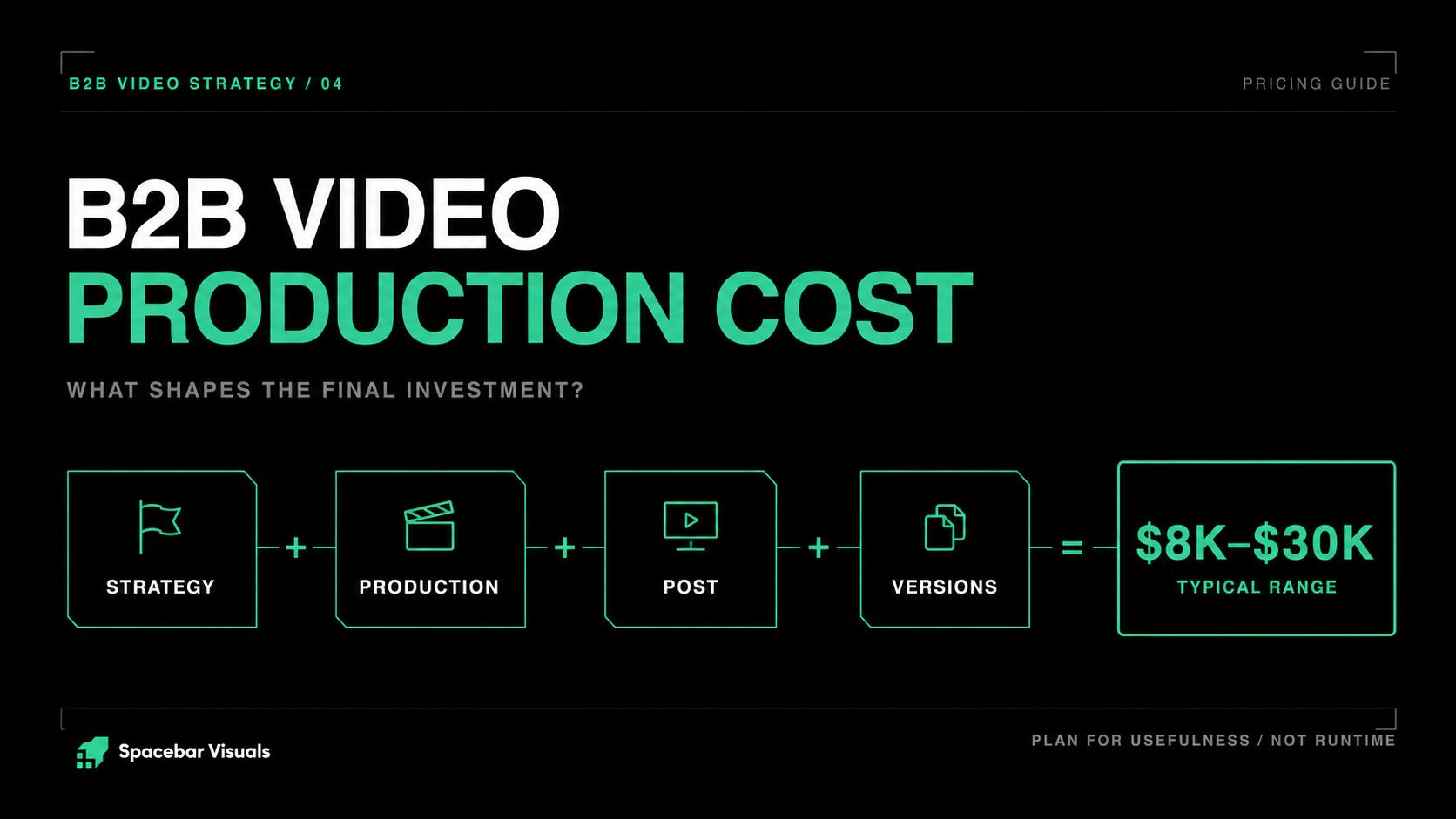
A professionally produced B2B video can cost anywhere from $5,000 to more than $50,000. Most focused projects fall between $8,000 and $30,000, depending on the strategy, creative approach, production requirements, and number of final assets.
That range is wide because buyers are rarely comparing identical projects. A 45-second animated product explainer, a customer story filmed in two locations, and a brand video featuring several executives may have a similar runtime, but they require very different teams and processes.
The better question is not simply, “How much does B2B video production cost?” It is: What investment will produce a video capable of achieving the intended business objective?
This guide explains typical pricing ranges, the factors that influence video production cost, what a professional quote should include, and how to set a budget.
Typical B2B Video Production Cost by Project Type
The following ranges help marketing teams set an initial budget before speaking with a production partner.
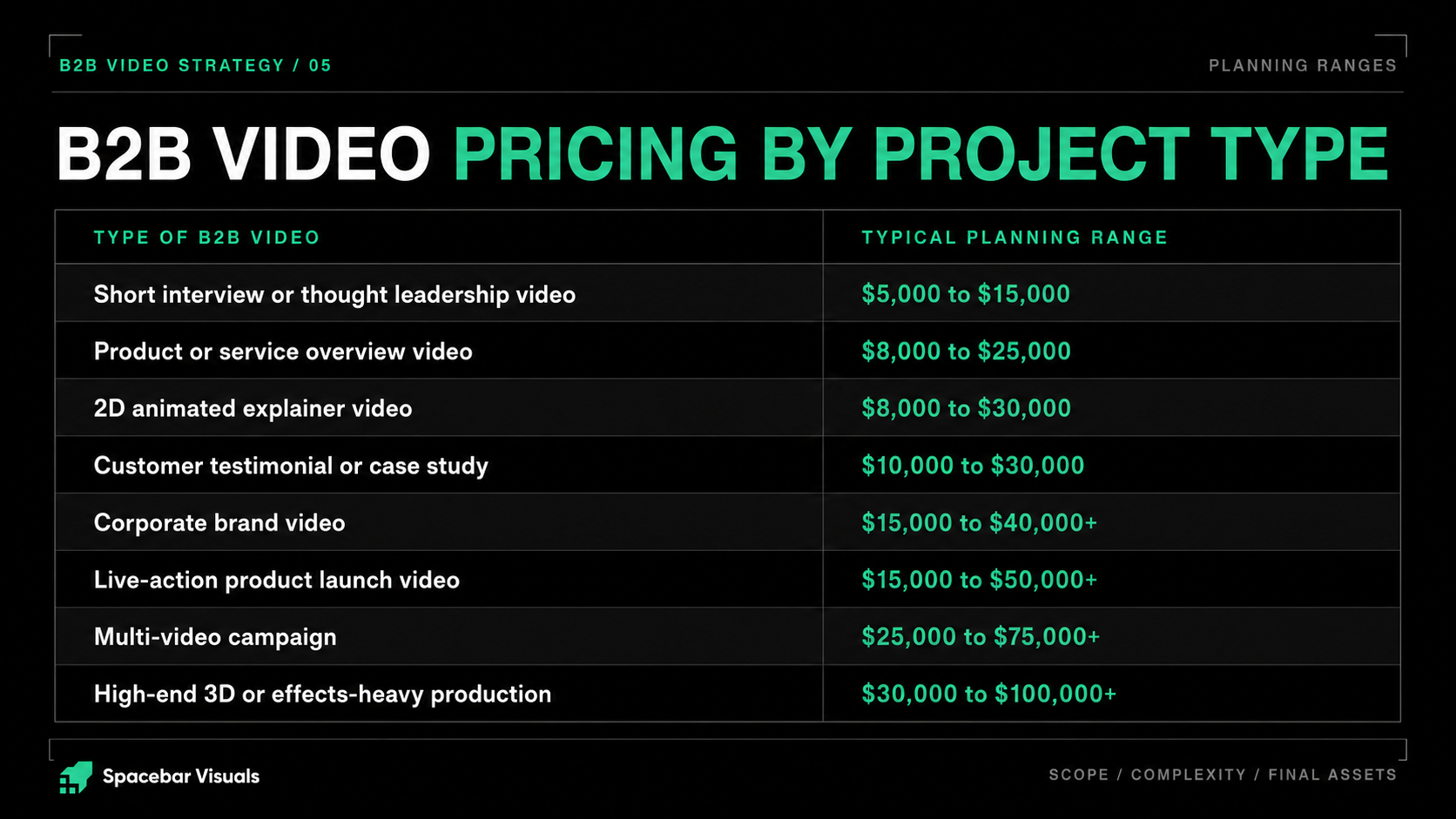
These ranges overlap because format alone does not determine cost. A simple customer interview filmed at one office may cost less than an animated explainer requiring technical research, custom illustration, and detailed product visualization.
Runtime also matters less than many buyers expect. A polished 30-second video can cost more than a five-minute interview because every second may require custom animation, precise art direction, sound design, and detailed review.
What Determines B2B Video Pricing?
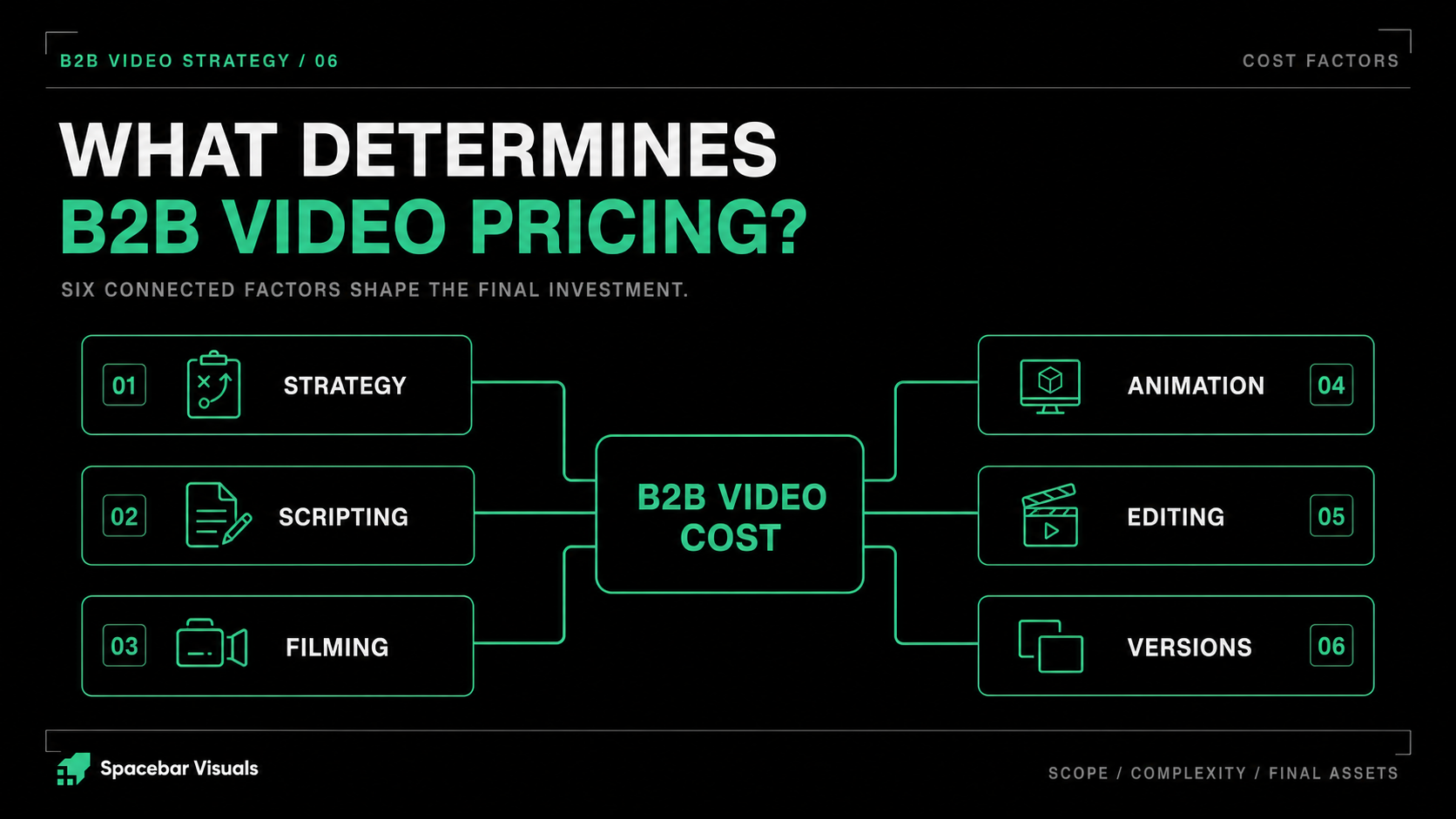
Much of the budget covers the work completed before and after filming. Strategy, scripting, editing, animation, and stakeholder management often require more time than the shoot itself.
1. Strategy and discovery
A strategic video partner should determine whether the requested video is the right asset for the goal. Discovery typically defines the audience, business objective, buyer stage, core message, distribution channels, and measures of success.
For example, a homepage video and a paid social ad should not communicate in the same way. A homepage visitor may already recognize the company, while a social viewer may have no context and only a few seconds of attention. Strategic work increases the initial investment, but reduces the risk of producing an attractive video that does not fit the campaign.
2. Concept development and scripting
The creative concept determines what viewers see, how the story progresses, and why the message deserves their attention. Script costs depend on the technical complexity of the subject, amount of research, number of interviews, and number of stakeholders involved.
B2B scripts are often challenging because the writer must translate a technical product into clear language without removing the details buyers need. The strongest scripts do not explain every feature. They focus on one audience, one problem, and one useful next step.
3. Live-action production
A live-action budget may include a producer, director, camera and lighting crew, audio equipment, location rental, actors, presenters, styling, travel, insurance, and permits.
A one-camera interview at a client’s office costs less than a two-day shoot involving several locations, actors, and product demonstrations. Internal participation also has a cost. Coordinating executives, subject-matter experts, and legal reviewers can affect the schedule even when it does not appear on the invoice.
4. Animation and visual complexity
Animation avoids some filming expenses, but it is not automatically cheaper. B2B explainer video production pricing depends heavily on the visual style and amount of custom work.
Kinetic typography and icon-based animation may be efficient. Custom illustration, character animation, detailed interface sequences, 3D product visualization, and mixed-media production require more specialist time.
If software is still evolving, the team must also decide whether to reproduce the current interface, simplify it, or create a stylized version that will remain useful after future product updates.
5. Editing and post-production
Post-production may include footage selection, editing, motion graphics, color correction, sound mixing, music licensing, voice-over, captions, visual effects, and product screen replacement.
Costs rise when there is extensive source footage or the story was not clearly defined before filming. Reviews also matter. Three coordinated feedback rounds are very different from separate comments arriving from marketing, product, sales, legal, and executives at different times.
6. Versions and campaign assets
A campaign might require a 90-second main video, 30- and 15-second cutdowns, vertical and square formats, captions, alternate calls to action, sales clips, event versions, and still images.
These assets increase editing time, but can improve the return on the original production. Planning them early allows the team to capture the right dialogue, framing, and supporting footage during the main production.
What Does Each Budget Level Buy?
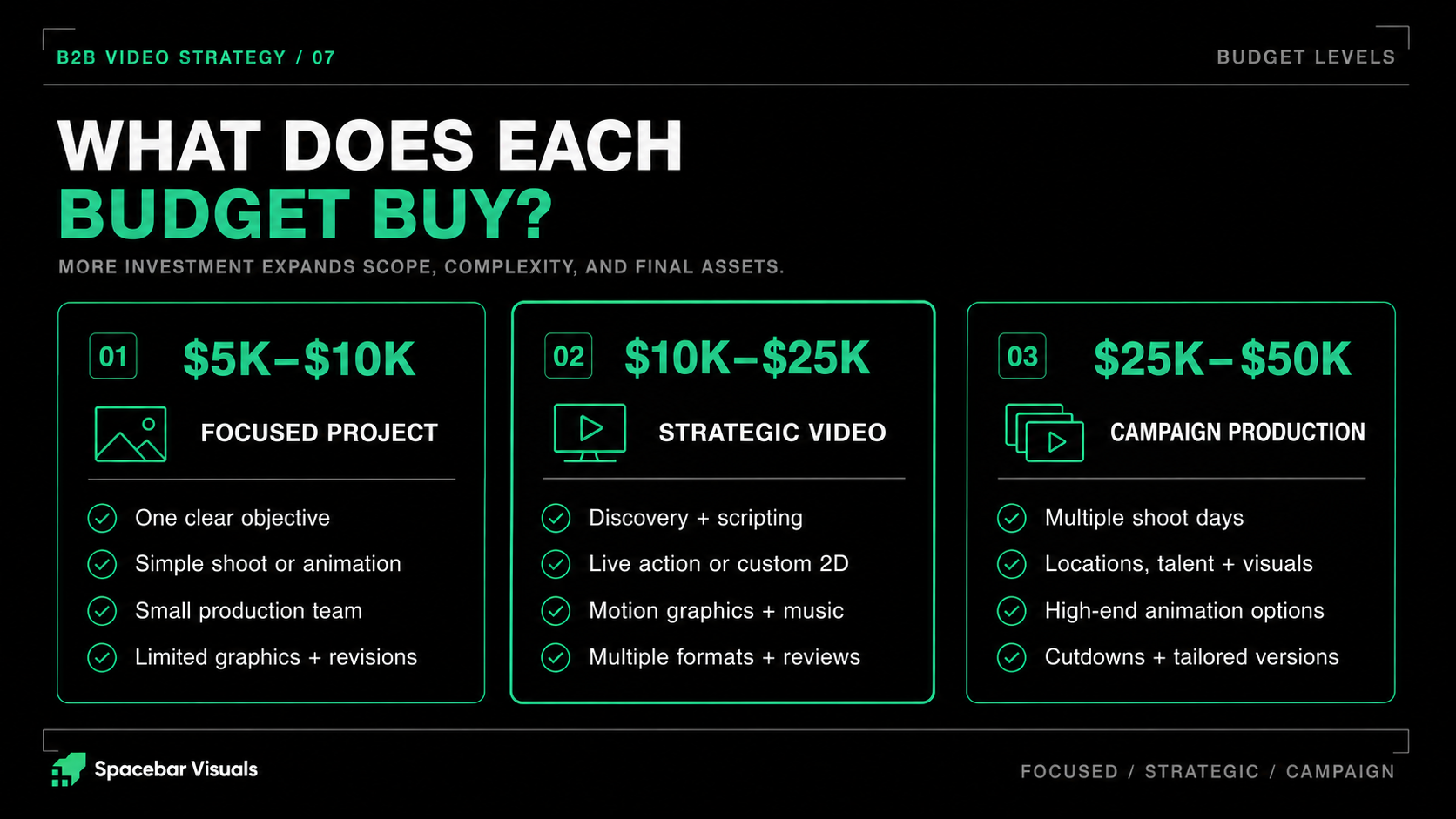
There is no exact formula, but these scenarios illustrate how the scope can change at different investment levels.
$5,000 to $10,000: A focused project
This level can support a simple project with one objective, one location or a straightforward animation style, a small team, limited graphics, and a defined number of revisions.
For example, a subject-matter expert could record a concise educational video supported by branded titles, product screenshots, and one social cutdown. This range is less suitable for a complex brand story, several filming locations, custom 3D animation, or a large review group.
$10,000 to $25,000: A strategic B2B video
This common planning range can cover strategic discovery, concept and script development, professional live action or custom 2D animation, motion graphics, licensed music, multiple review rounds, and several final formats.
The result could be a polished product overview, customer story, animated explainer, or campaign video. The video should begin with a clear use case, such as supporting a landing page and then being adapted for paid media and sales outreach.
$25,000 to $50,000: A campaign or complex production
At this level, a company may be building a connected collection of assets rather than one isolated video. The scope could include multiple filming days, several locations, actors, high-end animation, product visualization, audience-specific versions, and a planned library of cutdowns.
A product launch, for example, could include a main launch film, feature videos, paid ads, executive clips, event content, and sales enablement assets. The added value should come from greater usefulness, not complexity for its own sake.
Corporate Video Production Cost Versus Marketing Video Cost
“Corporate video” can refer to almost anything produced by a company, making corporate video production cost difficult to compare. A traditional corporate video might present a broad company overview.
A marketing video usually has a narrower job: introduce a product, explain a problem, support a launch, provide customer proof, educate a buying group, or help sales address an objection.
Budget around the video’s job rather than its label. A technical product explainer should be evaluated differently from a brand film intended to increase recognition. They may require similar production resources, but their messaging, placement, and success metrics will differ.
Freelancer, Production Company, or B2B Video Agency?
A freelancer can be economical when your team already controls the concept, script, approvals, and distribution. Your company may still need to manage strategy and additional specialists.
A general production company suits teams with clear creative direction. Confirm whether its proposal includes research, messaging, scripting, and channel planning or mainly production.
A B2B video marketing agency is valuable when you need help deciding what to make. A specialist can account for technical products, long buying cycles, multiple decision-makers, and the needs of product marketing, demand generation, sales, and customer education.
How to Compare Video Production Quotes
The lowest quote is not always the least expensive option. A video that must be rewritten, reshot, or replaced after launch can cost more than a properly planned production.
When comparing proposals, confirm:
- Whether strategy, research, and scriptwriting are included
- How custom the creative and visual approach will be
- The runtime, aspect ratios, cutdowns, captions, and alternate versions included
- How many review rounds are allowed and what counts as a revision
- Who owns and may use the footage, animation, music, voice-over, and project files
- Whether travel, talent, studios, stock assets, localization, or extra edits cost more
A proposal that promises only a “two-minute video” is not detailed enough for a useful comparison. The scope should make responsibilities, deliverables, exclusions, and approval stages clear.
How to Set the Right B2B Video Budget
Start with the business case rather than the desired production style.
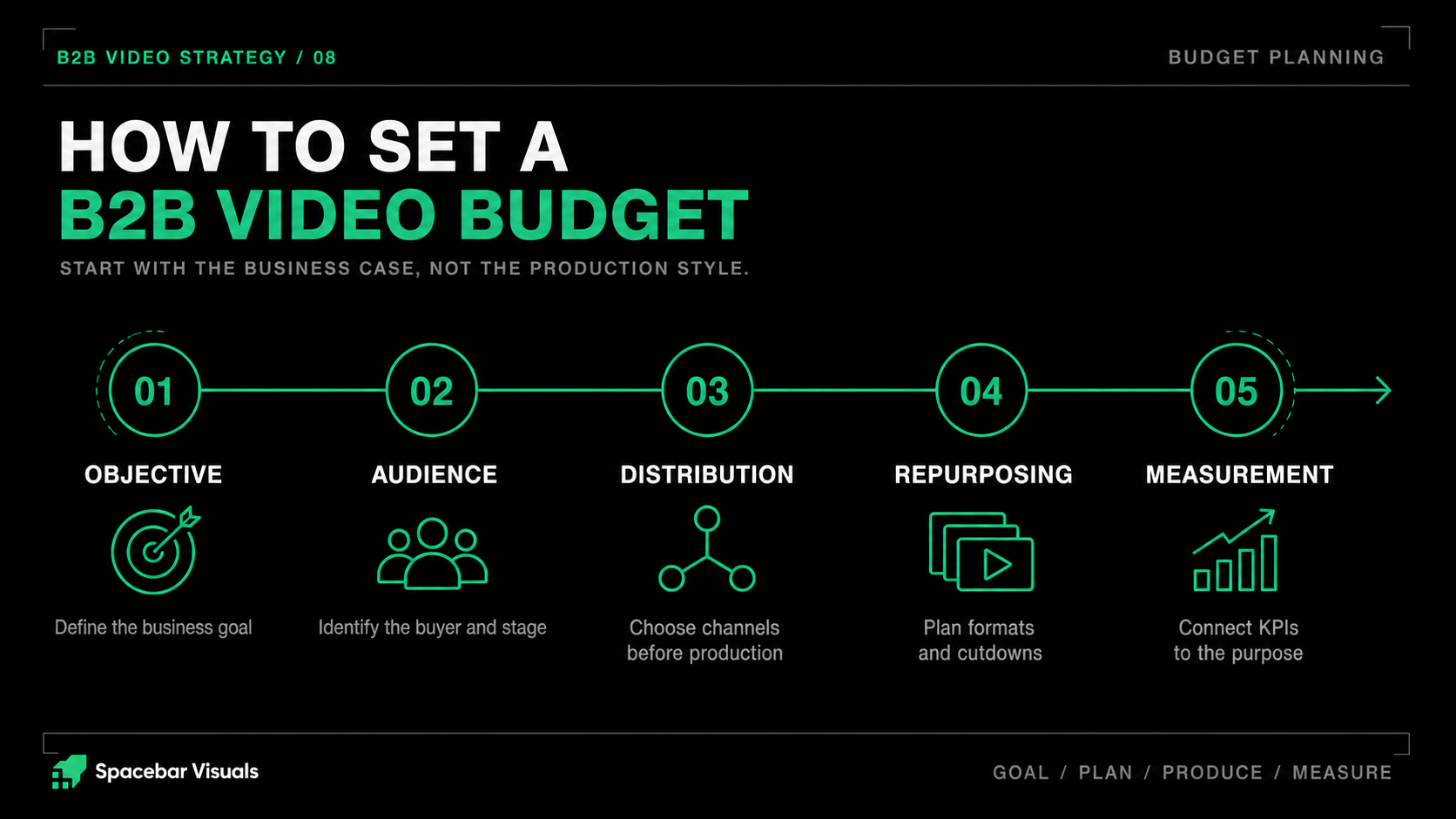
Define the objective and audience
Decide whether the video should generate awareness, explain a product, support sales, increase event engagement, or educate customers. Then identify the specific audience and buying stage. A technical evaluator needs different information from a CFO, while an existing customer needs different context from a new prospect.
Confirm distribution before production
List where the video will appear, such as website pages, advertising, social media, email, sales outreach, presentations, webinars, trade shows, or onboarding. Distribution affects the opening, length, format, call to action, and number of versions.
Plan repurposing and measurement
Do not wait until the main video is finished to request shorter edits. If repurposing is planned early, the team can capture material suited to every required channel.
Choose measures that reflect the video’s purpose. These may include landing-page conversions, qualified meetings, ad engagement, sales usage, influenced opportunities, event registrations, product adoption, or completion rate. A brand video should not be judged only by immediate leads, while a sales enablement video should not be judged only by public views.
Where to Save and Where to Invest
If the budget is limited, simplify logistics before weakening the strategy. Consider reducing the number of locations, shoot days, actors, final versions, visual effects, or custom sets.
Be careful about cutting discovery, audience definition, script development, subject-matter accuracy, sound quality, project management, or distribution planning. A clearly positioned video with a controlled visual approach is generally more useful than an expensive production built around an overcrowded message.
The Best B2B Video Budget Is Based on Usefulness
There is no single correct B2B video pricing model. A company might reasonably spend $8,000 on one focused explainer or more than $50,000 on a multi-asset product launch.
Before approving a project, answer four questions:
- Who is the video for?
- What should the viewer understand or do?
- Where will the video be distributed?
- How will it support marketing or sales after launch?
If those answers are unclear, the project is not ready for production, regardless of budget. If they are clear, a capable partner can recommend the simplest approach that will accomplish the goal effectively.
Frequently Asked Questions
How much does B2B video production cost?
Most professionally produced B2B videos require a budget of $8,000 to $30,000. Simple projects may cost less, while premium live-action work, advanced animation, and multi-video campaigns can exceed $50,000.
How much does a B2B explainer video cost?
B2B explainer video production pricing commonly falls between $8,000 and $30,000 for professional 2D animation. Custom illustration, technical research, 3D animation, and multiple versions increase the investment.
How can we reduce costs without reducing quality?
Limit locations, shoot days, formats, and visual complexity. Keep one clear audience and objective, but retain the strategy, scripting, sound quality, and distribution planning that make the video effective.
Ready to Plan Your B2B Video?
Spacebar Visuals has helped more than 100 companies, including ISO, Rho, and Cloaked, produce B2B videos for marketing, sales enablement, customer education, events, and brand awareness.
Book a video strategy call to discuss your objective, audience, distribution plan, and the right production scope.
Let’s build your product story together


View Related Resources

8 B2B Customer Testimonial Video Examples That Work
How to Create a B2B Customer Testimonial Video
