How to Choose a B2B Video Production Company


How to Choose a B2B Video Production Company
Choosing the right B2B video production company starts with one question: Can this partner help you create a video that supports a business objective, or will they simply deliver something that looks polished?
A strong partner should define the audience, message, buyer stage, distribution plan, and desired action before discussing production style. Beyond its portfolio, evaluate its B2B experience, process, communication, pricing, and ability to create several useful assets from one concept.
Here is how to make the right decision.
Start With the Business Objective
Before comparing production companies, define the job your video needs to perform.
Possible objectives include explaining a product, supporting a launch, generating interest, answering sales objections, building trust, increasing registrations, educating customers, or strengthening brand awareness.
This matters because a homepage video should not be planned like a paid social ad. A homepage visitor may already know your company and want to understand your offer. Someone seeing a LinkedIn ad may know nothing about your brand and have only a few seconds to decide whether the message is relevant.
A capable B2B video agency should ask about these differences early. If the first conversation focuses entirely on runtime, equipment, or animation style, the strategic foundation may be missing.
Before contacting an agency, complete this sentence:
We need to help [specific audience] understand [specific message] so they will [specific action], and we plan to reach them through [specific channels].
For example, you may need operations leaders to understand how your platform reduces manual reporting so they request a demo. That gives a partner more useful direction than “We need a 90-second explainer.”
What Should You Look for in a B2B Video Production Company?
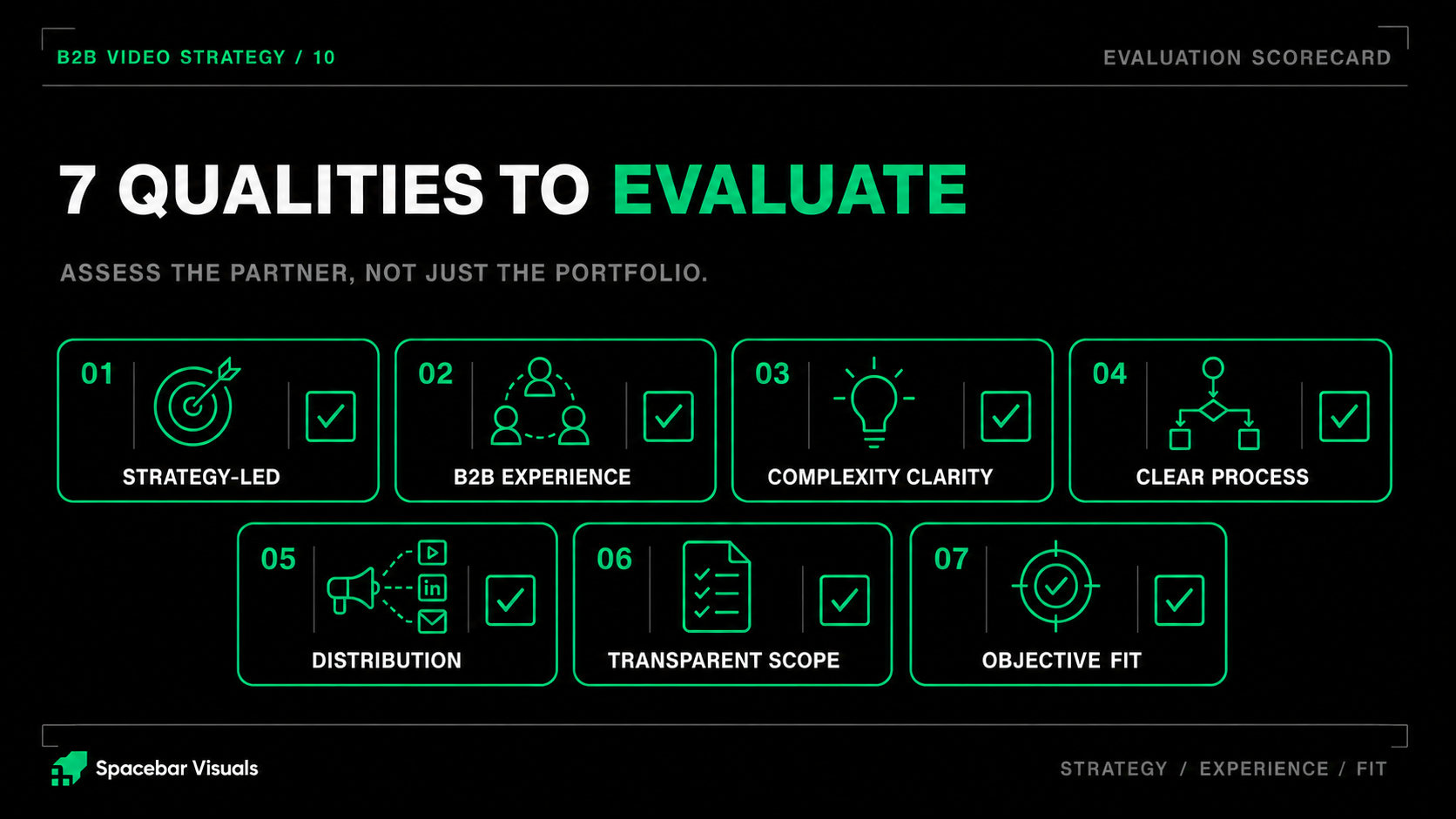
The right partner combines B2B marketing judgment with dependable creative execution. Look for these qualities:
- A strategy-led process
- Relevant B2B experience
- The ability to simplify complex products
- A clear production and approval process
- Distribution and repurposing knowledge
- Transparent pricing and scope
- Work that fits your objective, not only your visual taste
Each quality reduces a different type of project risk.
1. Look for Strategy Before Production
A good-looking video can still fail if it addresses the wrong audience, communicates too much, or appears in a channel where the format does not fit.
Your production partner should identify the primary viewer, the problem that matters to them, the central message and supporting evidence, where the video will appear, the desired next action, and how performance will be evaluated.
This does not mean every project requires months of research. It means creative decisions should follow a clear marketing rationale.
Strong B2B video does not communicate everything at once. It gives a defined audience the right information for that stage of the journey.
2. Confirm That the Company Understands B2B Buying
B2B projects often involve long buying cycles, technical content, several decision-makers, legal reviews, and pressure to connect marketing activity to revenue.
A general video production company or corporate video production company may produce excellent work but still expect your team to provide the strategy, approved script, product knowledge, and distribution plan. That can work if you have an experienced internal content team. It is less suitable when you need help deciding what to create and how to use it.
A specialized partner should understand that a chief financial officer, technical evaluator, department head, and end user can influence the same purchase while caring about different outcomes. One video rarely needs to address all of them. The agency should help determine which viewer matters most for each asset.
3. Evaluate How Well They Explain Complex Products
B2B companies often sell products that are technical, unfamiliar, or difficult to show on camera.
This is especially important when choosing a B2B video production company for SaaS. The agency may need to turn interfaces, integrations, workflows, or data processes into a story buyers can understand quickly.
Ask for examples involving technical software, abstract services, multi-step workflows, regulated industries, or products with several user types. Focus on the clarity of the explanation, not only the animation quality.
A useful SaaS video should establish the business problem, show how the product changes the user’s experience, and explain the outcome without becoming a narrated feature list.
Ask how the agency learns technical subject matter through demonstrations, interviews, sales materials, recordings, and subject-matter experts. It needs a reliable process for writing clearly and accurately.
4. Review the Portfolio With the Right Questions
Buyers often judge a polished portfolio based only on personal taste. Do not ask only, “Do we like this style?”
Ask whether the audience is clear, the message is immediately understandable, the opening creates relevant interest, the visuals support the explanation, the next action is logical, and the format suits the intended channel.
A cinematic brand film does not prove that an agency can create a clear SaaS explainer. Look for evidence that matches your objective.
When searching for the best B2B video production company, “best” should mean the best fit for your objective, audience, internal team, and distribution plan. It should not simply mean the company with the most impressive showreel.
5. Understand the Production Process
A clear process protects the schedule, budget, and finished work. Most professional projects include four phases.
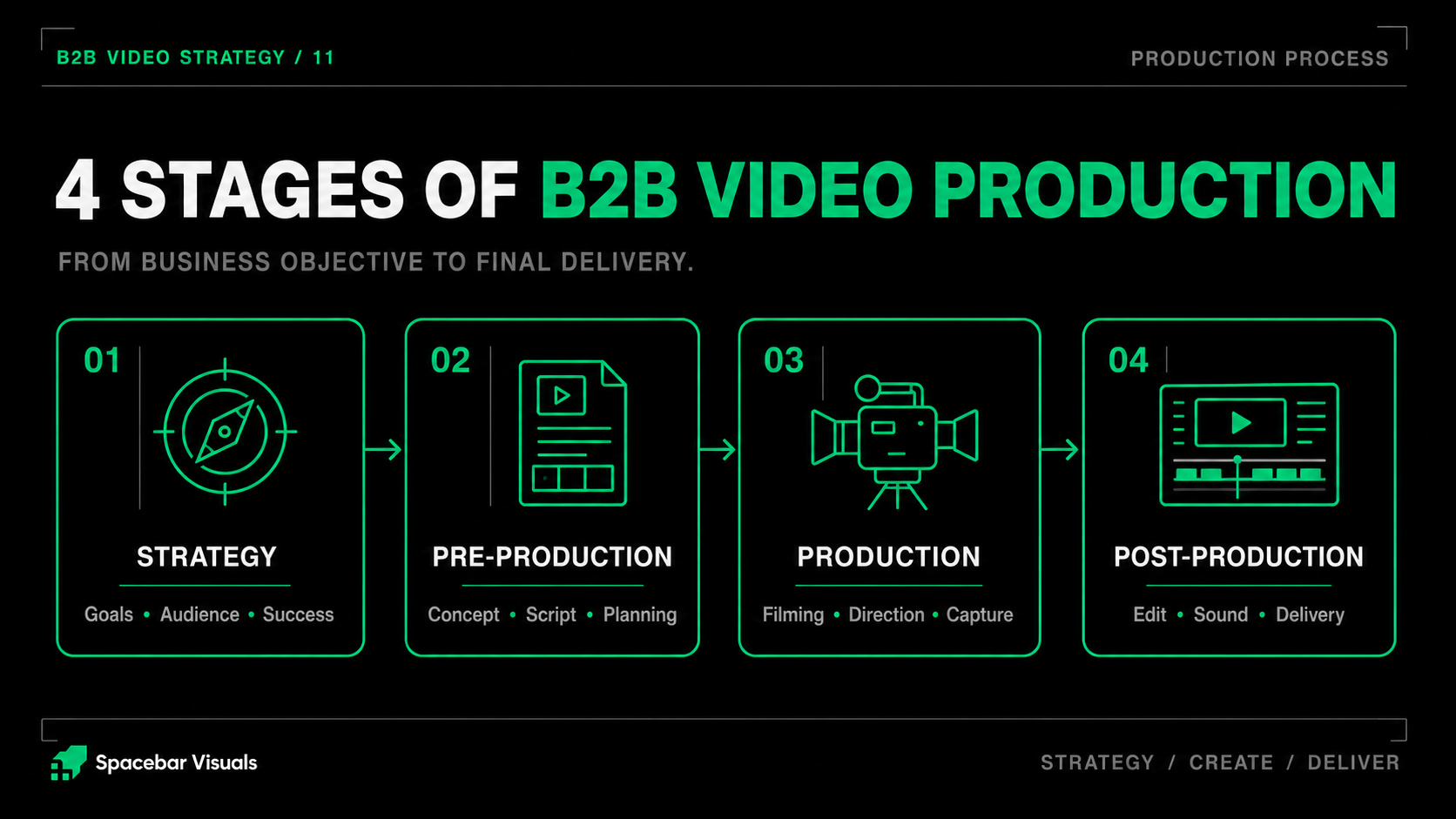
Strategy and discovery
The agency learns about the objective, audience, product, market, buyer journey, and distribution plan. The output may include a creative brief, messaging direction, or recommended video plan.
Pre-production
The team develops the concept, script, storyboard, visual direction, interview plan, schedule, and filming requirements. Important decisions should be made here. Changing a sentence during scripting is simple; changing the same idea after filming or animation is expensive.
Production
The team films, records voice-over, captures product footage, creates illustrations, or produces other visual elements. For live action, confirm who manages locations, interview preparation, travel, talent, and release forms.
Post-production
The team edits footage, builds animation, adds graphics, mixes audio, applies color correction, and prepares final versions. Ask how feedback is collected and how many review rounds are included.
Appoint one internal owner to consolidate comments and send approved feedback. Conflicting instructions from multiple departments can quickly delay a project.
6. Discuss Distribution and Repurposing Early
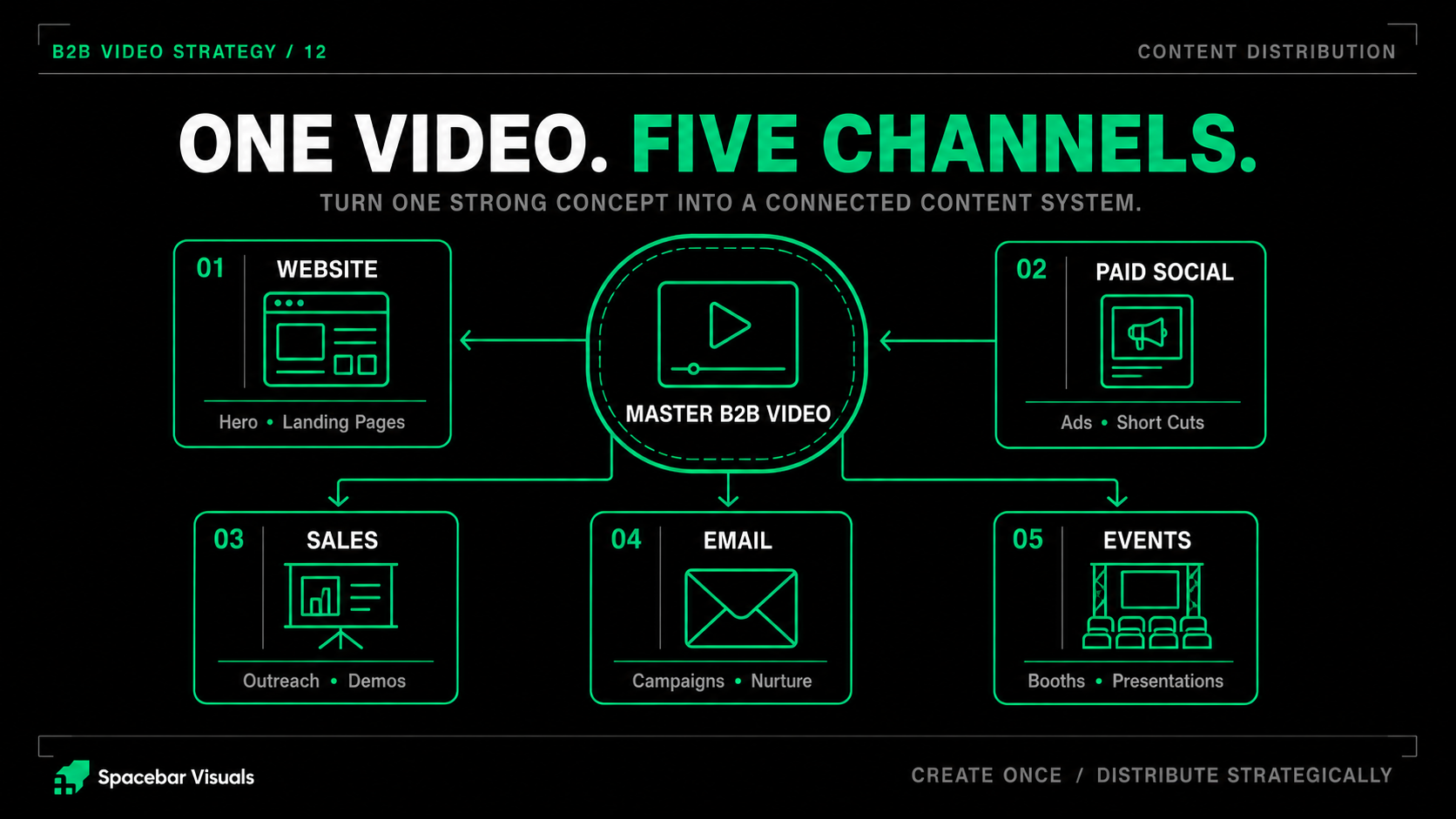
A video’s destination affects how it should be created. Tell the agency whether the content will be used on a homepage, landing page, paid ad, organic social post, email, sales presentation, trade show display, webinar, or onboarding sequence.
These channels may require different openings, lengths, aspect ratios, captions, and calls to action. A horizontal video may become unreadable when cropped vertically, while a slow introduction may lose viewers in a social feed.
Video length should follow the viewer’s context, not a universal rule. Wistia’s analysis of more than 13 million videos shows that different lengths support different viewing behaviors. The practical lesson is to match runtime to purpose rather than making every video as short as possible. Wistia’s 2026 State of Video Report
A strong concept should rarely produce only one file. A customer interview could support a main story, proof-point clips, sales outreach, social posts, and a written case study.
Every version should have a defined use. Ask which additional assets can be created efficiently, what must be captured during the original shoot, which formats are included, and whether calls to action can change by channel.
7. Compare Proposals Based on Scope
Two proposals with the same price may include very different support. A detailed proposal should explain:
- Strategy, concept development, and scriptwriting
- Storyboarding and visual direction
- Filming days, crew, or animation style
- Voice-over and music
- Number and length of deliverables
- Aspect ratios, cutdowns, and captions
- Review rounds and timeline
- Usage rights and source file ownership
- Third-party expenses and exclusions
Be cautious with proposals that describe only runtime and production style. “Create one two-minute animated video” does not reveal whether the quote includes research, custom illustration, interface animation, voice-over, captions, cutdowns, or stakeholder revisions.
The lowest proposal may require your team to do more work. That is not necessarily a problem, but it should be clear. Compare the complete commitment required from both sides, including the time your team will spend managing the project.
8. Include Accessibility
Accessibility should be included in production planning. Ask about captions, readable text, sufficient contrast, transcripts, and visuals that do not rely only on color.
The Web Content Accessibility Guidelines state that captions should be provided for prerecorded synchronized media when audio is necessary to understand the content. W3C guidance on prerecorded captions
Confirm whether caption files, burned-in captions, and transcripts are included in the scope.
Questions to Ask a B2B Video Agency
Use these questions during introductory calls:
- How do you decide which video a company should create?
- How do you connect the concept to a business objective?
- How do you learn complex products?
- Can you show work created for a similar objective?
- Who will manage the project and write the script?
- How do you manage feedback and approvals?
- Which formats, cutdowns, captions, and transcripts are included?
- How many review rounds are included?
- Who owns the footage and project files?
- What could create an additional charge?
The agency’s questions also provide evidence. A partner that challenges unclear assumptions may offer more strategic value than one that immediately confirms every request.
Common Warning Signs
Consider other options if a company:
- Recommends a format before understanding the objective
- Cannot explain who will write the script
- Provides a vague scope
- Has no process for stakeholder feedback
- Treats every distribution channel the same way
- Promises results without understanding the campaign
- Cannot explain what your team must provide
A good partner should be confident without guaranteeing outcomes that production alone cannot deliver. Results also depend on targeting, distribution, sales follow-up, and market conditions.
How Should You Make the Final Decision?
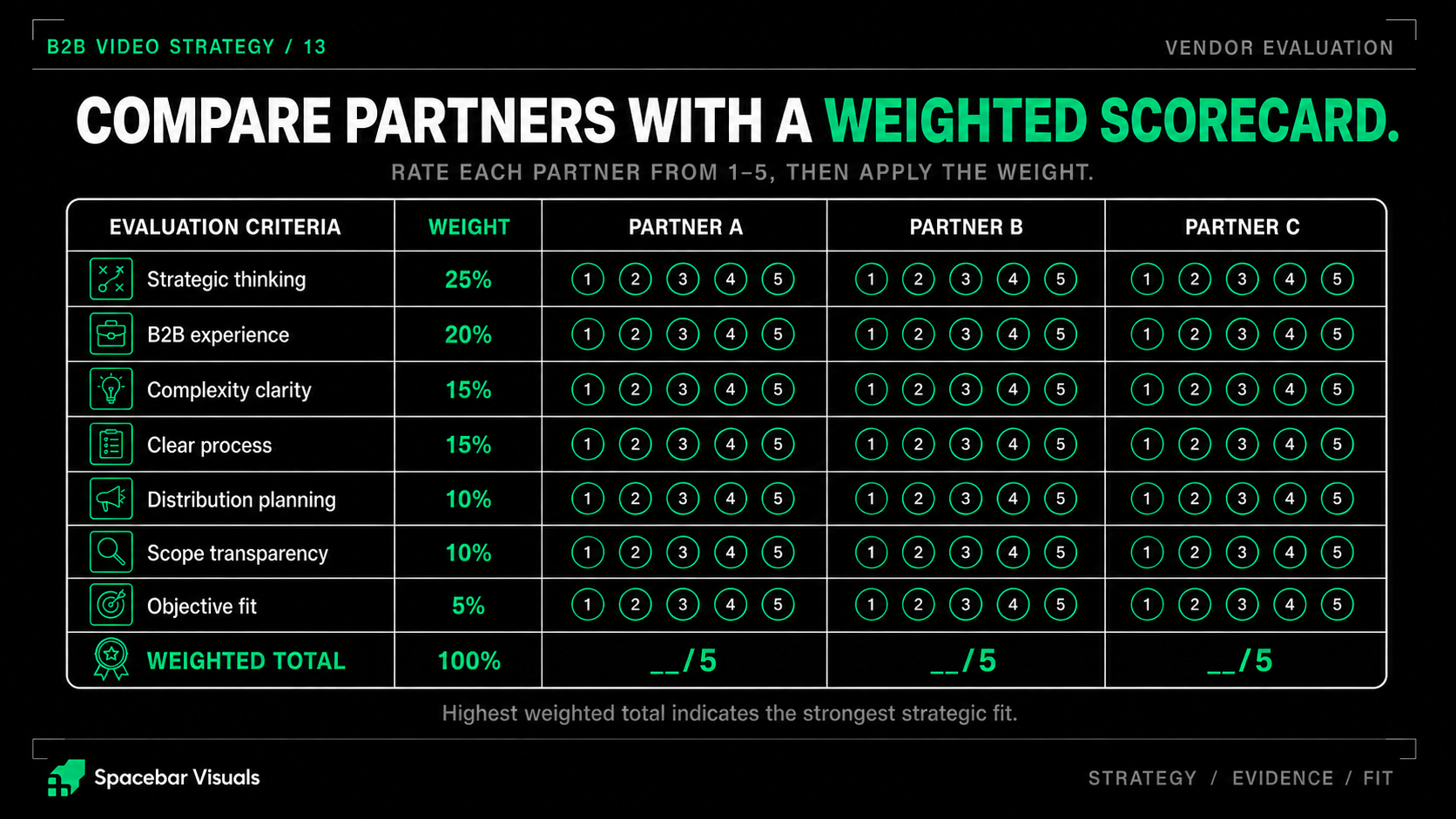
Score each shortlisted company against the same criteria.
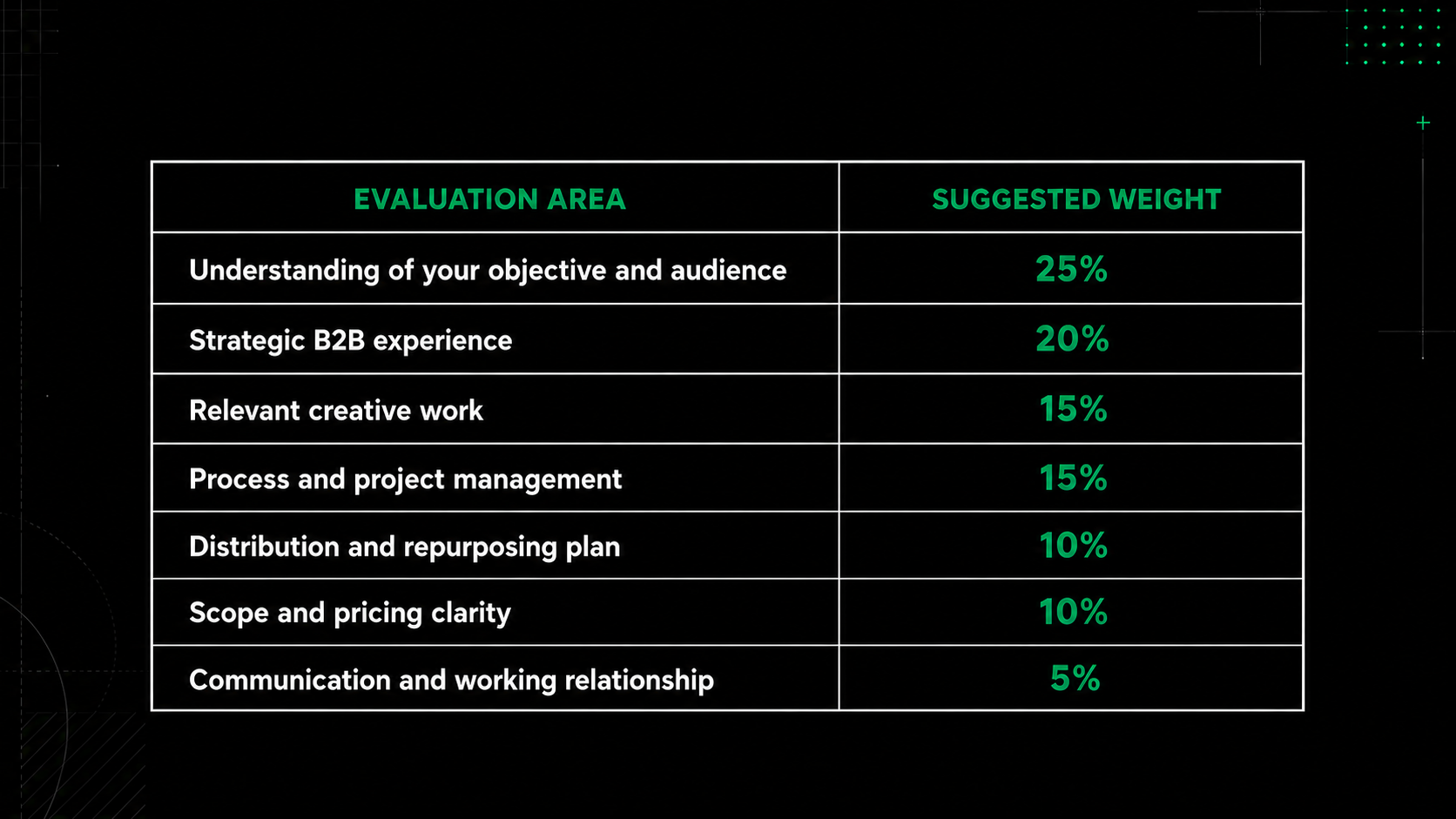
Adjust the weighting based on your capabilities. If you already have a final script and brief, execution may deserve more weight. If you are unsure what to create, prioritize strategy.
Consider starting with one defined project. It will reveal how the agency handles discovery, feedback, deadlines, and creative decisions.
Frequently Asked Questions
How do I find the best B2B video production company?
Define your objective, audience, channels, and internal support needs. Compare companies based on relevant experience, strategic thinking, process, scope, and communication. Do not decide based only on a showreel or the lowest price.
Should we hire a B2B video agency or a general production company?
Choose a B2B video agency when you need help deciding what to create, explaining a complex offer, and connecting content to marketing or sales. A general production company may suit teams that already have the strategy, script, and distribution plan.
Choose a Partner Who Understands the Video’s Job
The right B2B video production company does more than turn an approved script into a polished file. It helps determine what the video needs to achieve, who it should address, where it will be used, and what the viewer should do next.
Look for a partner that understands B2B buying, can simplify technical information, manages stakeholders well, and plans distribution before production begins.
Spacebar Visuals helps companies create videos for product marketing, demand generation, sales enablement, customer education, events, and brand awareness. We have worked with more than 100 companies, including ISO, Rho, and Cloaked.
Book a video strategy call with Spacebar Visuals to discuss your objective, audience, distribution plan, and production needs.
Let’s build your product story together


View Related Resources

8 B2B Customer Testimonial Video Examples That Work
How to Create a B2B Customer Testimonial Video
